The Jaco Challenge: What's It Like to Remove the Frets on Our Tuned Earth?
And Is the Fretless Music Worth Listening To?
The Metaphor: Fretless as Expanded Possibility Space
In 1970s jazz fusion, Jaco Pastorius famously removed the frets from his electric bass. The conventional narrative focuses on what was lost: stability. Frets provide passive constraint, forcing notes into tune regardless of the player's skill or fatigue.
But Jaco didn't remove frets to make music harder. He removed them to make new music possible: continuous glissandos, microtonal harmonies, fluid pitch modulation that no fretted instrument could achieve. The cost was higher difficulty. The reward was access to unexplored tonal territory.
Going fretless can destroy the instrument or transform it into something that demands virtuosity while offering unprecedented expressive range. The outcome depends on the player's skill and the instrument's structural integrity.
The Planetary Question:
By systematically moving Rare Earth Elements (REEs) from quasi-permanent lithospheric storage into rapid-cycling technospheric use, Earth is undergoing a material phase transition. Are we destroying planetary stability, or developing a dual-memory architecture with slow geological storage coupled with fast technological processing? Or something else entirely?
Can we survive going fretless? If so, what music can we play? Do we have the collective improvisational skill to play it coherently? Or are we breaking the instrument beyond repair?
Earth's Emerging Dual-Memory Architecture
Think of Earth as a computing system developing planetary-scale cognition. It is building two complementary memory systems:
Lithosphere = Quasi-permanent solid-state memory (ROM/EEPROM analog)
- Write time: 10⁶ years (ore concentration via geological processes)
- Retention time: 10⁹ years (geologically stable storage)
- Bandwidth: Extremely low (millimeters per millennium of tectonic movement)
- Power requirement: Passive (no metabolic energy needed)
- Function: Deep-time reference, stable boundary conditions
Technosphere = Volatile fast-cycling memory (RAM analog)
- Write time: 10¹ years (mining and extraction)
- Retention time: 10⁰–10² years (device lifespan, then landfill dispersion)
- Bandwidth: Extremely high (nanosecond switching in circuits)
- Power requirement: Active (continuous energy input needed)
- Function: Real-time processing, rapid adaptation, high-speed signaling
Biosphere = The processor mediating between memory systems
- Evolved interfacing with slow lithospheric references (redox potentials, mineral boundaries)
- Now must also manage fast technospheric fluxes (dispersed REEs, altered thresholds)
- The "metabolic overhead" is cache coherency cost: maintaining consistency between two memory systems operating at radically different timescales
Is the mining-use-disposal cycle destruction, or a read-write-leak operation: reading from deep storage, loading into active memory, processing at high speed, then experiencing memory corruption as devices end up in landfills and REEs disperse into the environment? The distinction matters.
The Physics of Memory Elements
In the language of Carver Mead's Collective Electrodynamics, stable information storage requires spectral impedance matching: components that lock energy exchange into specific, resonant modes.
Rare Earth Elements (REEs) function as high-Q memory elements due to their unique quantum architecture:
- Shielded Invariance: The chemically active electrons are buried in the 4f subshell, shielded by outer layers. This makes REE spectral lines and magnetic moments incredibly sharp (high-Q) and resistant to environmental drift.
- Dual-Mode Operation: In lithospheric storage, REEs act as passive reference standards (redox pinning, magnetic boundary conditions). In technospheric devices, the same properties enable active processing (coherent light emission, magnetic field generation, precision timing).
The table below reveals this duality: technosphere uses overwhelmingly exploit coherence, phase stability, and controlled delay, the same properties that stabilize geological boundary conditions.
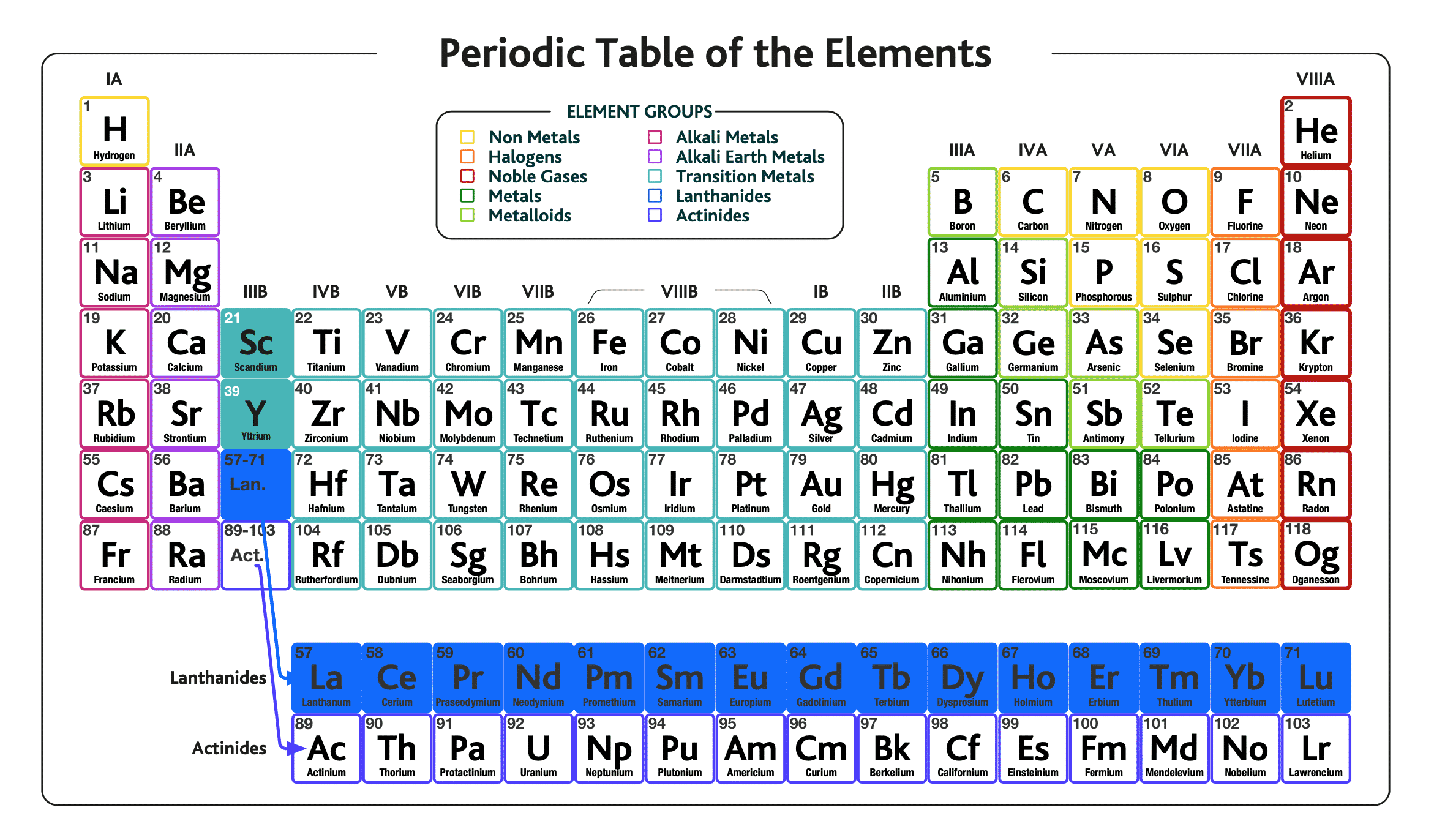
The Dual Nature of REEs: Storage vs Processing
| Element | Symbol | Primary Technosphere Uses | Hypothesized Lithosphere / Earth-System Role (Conceptual) |
|---|---|---|---|
| Scandium | Sc | Aerospace alloys, SOFCs | Lattice strengthening; stabilizing defects and grain boundaries |
| Yttrium | Y | LED phosphors, YAG lasers | Phase stabilization in oxides; damping lattice noise |
| Lanthanum | La | Batteries, oil catalysts, welding electrodes (arc stability) | Redox buffering at mineral–fluid interfaces; ion channel gating/blocking |
| Cerium | Ce | Catalytic converters, polishing | Redox phase switch pinning local oxidation states |
| Praseodymium | Pr | Magnets, aircraft engines | Magnetic susceptibility tuning; slow spin-lattice coupling |
| Neodymium | Nd | Permanent magnets (EVs, turbines) | Persistent magnetic ordering; long-term field coherence |
| Promethium | Pm | Atomic batteries | Limit case: radioactive delay and decay-mediated memory |
| Samarium | Sm | High-T magnets, reactor rods | Neutron absorption; magnetic stabilization |
| Europium | Eu | Display phosphors | Valence-sensitive charge trapping |
| Gadolinium | Gd | MRI contrast, shielding | Strong paramagnetism coupling thermal and magnetic modes; ion channel gating/blocking |
| Terbium | Tb | Green phosphors, sonar | Magnetoelastic coupling |
| Dysprosium | Dy | Heat-resistant magnets | Magnetic stability under thermal stress |
| Holmium | Ho | Lasers, flux concentrators | Extreme magnetic moment; localized field concentration |
| Erbium | Er | Fiber-optic amplifiers | Long-lived electronic transitions; resonance preservation |
| Thulium | Tm | Portable X-ray devices | Metastable electronic states; slow decay channels |
| Ytterbium | Yb | Atomic clocks, fiber optics | Precision frequency reference embedded in lattice |
| Lutetium | Lu | PET scanners, lithography | High-Z damping; fine-scale energetic smoothing |
The table reveals the paradox: we mine REEs for their processing capabilities (lasers, magnets, displays), but in doing so, we relocate them from their storage function (geological reference frames). The question is whether Earth's cognitive architecture can maintain coherence across this timescale discontinuity.
Timescale Compression: From Geological Deep-Time to Nanosecond Circuits
The movement of REEs from lithosphere to technosphere represents an 18-order-of-magnitude compression of operational timescale.
Consider the life cycle of a Neodymium atom:
In Lithospheric Storage:
- Concentration via hydrothermal processes: 10⁶–10⁸ years
- Residence time in stable mineral lattice: 10⁹ years
- Participation in redox buffering: continuous, passive, zero-energy
- Information content: Stable boundary condition, "geological constant"
In Technospheric Processing:
- Extraction and refinement: ~10¹ years
- Integration into permanent magnet: ~10⁰ years
- Magnetic domain switching in motor: 10⁻³ seconds
- Service life in electric vehicle: ~10 years
- Post-landfill dispersion: begins immediately, continues indefinitely
- Information content: High-speed signal, then noise
Is this resource depletion or architectural transformation? Are we converting deep-time reference frames into high-bandwidth processing elements, then losing coherence as they disperse? Or is this distinction meaningless?
The computational metaphor: imagine copying data from a 10⁹-year-retention solid-state drive into volatile RAM that loses data after 10 years, processes it at gigahertz speeds, then has the RAM contents leak randomly into the environment. Can the system maintain its computational integrity if enough of its stable storage is migrated to volatile, leaky memory? Is there a threshold beyond which coherence becomes impossible?
Mechanisms of Threshold Modulation: How Memory Architecture Affects Processing
The dual-memory architecture has physical consequences. REEs don't just store information; they define the voltage thresholds that determine when systems switch states. Moving them from stable storage to dispersed volatility changes the reference voltages that biological and atmospheric systems use for computation.
Mechanism 1: Atmospheric Discharge Thresholds
In industrial welding, pure tungsten electrodes require high voltage (~4.5 eV work function) to initiate an arc. By adding 1-2% Lanthanum, creating Lanthanated Tungsten, the work function drops to ~2.8 eV. This means:
- Lower ignition voltage – the arc starts more easily
- More stable discharge – the arc sustains at lower power
- Easier re-ignition – the electrode remains "primed" between cycles
The mechanism is quantum-mechanical: La atoms at the surface donate electrons more readily, lowering the energy barrier for thermionic emission.
The Atmospheric Parallel:
When REE dust (from mining, e-waste incineration, industrial abrasion) disperses into the atmosphere, particulate matter coated with or containing REEs may act as lanthanated aerosols. These particles could:
- Lower the effective work function of charged aerosols
- Reduce the breakdown voltage required for lightning initiation
- Create "hair-trigger" discharge conditions during storm formation
A possible result: a sky with a lower, more variable impedance threshold, where electrical discharge becomes statistically more probable at lower charge accumulation. Is this degradation or increased sensitivity? Does the atmosphere gain bandwidth (responding to smaller perturbations) while losing noise immunity (more susceptible to false triggers)? Or is the effect negligible at planetary scales?
Mechanism 2: Biological Ion Channel Thresholds
Calcium (Ca²⁺) is the universal biological "on-switch." When Ca²⁺ enters a cell through voltage-gated channels, it triggers:
- Neuron firing (action potentials)
- Muscle contraction
- Hormone secretion
- Gene expression
Rare earth ions (Ln³⁺, where Ln = La, Gd, etc.) are calcium mimics with three critical differences:
- Size similarity: Ionic radius of
Ln³⁺(0.95–1.15 Å) overlaps withCa²⁺(1.00 Å) - Higher charge:
+3vs+2creates stronger electrostatic binding - No biological function: Once bound,
Ln³⁺cannot perform calcium's signaling role
When REEs enter biological systems (via water, food, dust inhalation), they act as "super-calcium", binding to calcium channels, transporters, and signaling proteins with higher affinity but jamming the downstream mechanism.
The Threshold Effect:
Ca²⁺channels become blocked or require higher voltage to open- Nerve firing thresholds shift upward or become erratic
- Metabolic processes requiring precise calcium timing (heartbeat, circadian rhythm) develop jitter
The cell must now expend additional ATP to:
- Pump out the non-functional
Ln³⁺ions - Compensate for scrambled signaling by increasing feedback loop speed
- Maintain voltage gradients in the presence of higher-affinity blockers
Detuning as Bandwidth Expansion
Both mechanisms share a common structure:
- Lithosphere-Anchored State: Well-defined, stable energy thresholds act as reference voltages (work function, channel voltage). Low bandwidth, high noise immunity.
- Technosphere-Mediated State: Thresholds become lower, more variable, or blocked. Higher bandwidth (more responsive), lower noise immunity (more erratic).
Is this toxicity in the classical sense, or architectural transition: from a system optimized for stability over geological time to one optimized for responsiveness over technological time? Can the biological processor (evolved for the former) adapt its algorithms to operate coherently in the latter? Or will the transition exceed adaptive capacity?
Memory Corruption: The Landfill as Distributed Noise
The final stage of this process is the dispersion of REEs into landfills and the environment (e-waste). In the computational metaphor, this is memory leakage: data escaping from controlled storage into unstructured space.
- In Geological Storage: REEs are sequestered in coherent crystal lattices, providing stable, low-noise reference voltages for millions of years.
- In Technological Processing: REEs cycle through devices, providing high-speed, high-bandwidth functionality for years to decades.
- In Environmental Dispersion: REEs leach into groundwater, volatilize during incineration, and disperse as aerosols. They no longer provide either stable reference OR coherent processing. Instead, they act as stochastic perturbations: random noise in both atmospheric and biological threshold voltages.
Is this a memory corruption problem? If so, is the system losing data integrity not because storage capacity is depleted, but because data is leaking from structured memory (geological and technological) into unstructured space (environmental dispersion) where it contributes noise rather than signal? Or is the metaphor breaking down?
The Jaco Limit: Virtuosity, Not Survival
The Jaco Pastorius story provides the functional metaphor. After removing the frets from his bass, he did not simply "lose tuning." He entered a space where every note required continuous, active control. Minute finger position changes produced glissandos, slides, and microtonal shifts. The result was not noise; it was virtuosic expression, but only because Pastorius had the skill to maintain pitch accuracy across an expanded possibility space.
The analogy:
- Fretted bass: Lithospheric storage provides stable reference frames. Biological and atmospheric systems "snap to" tuned thresholds passively.
- Fretless bass: REE extraction removes stable references. Systems must now actively regulate what was once geometrically constrained. The possibility space expands (new materials, new technologies), but coherence requires continuous, skilled modulation.
Is The Jaco Limit a survival threshold or a virtuosity requirement? If the latter, what is the minimum collective improvisational skill needed to play coherent music on a fretless planetary instrument? Can we even define such a limit?
If this limit exists, what determines it?
- Bandwidth Mismatch: The 18-order-of-magnitude gap between geological and technological timescales
- Noise Floor: The concentration and spatial distribution of dispersed REEs acting as stochastic perturbations
- Metabolic Overhead: The ATP and entropy costs of active compensation (ion pumping, error correction, detoxification)
- Algorithmic Adaptation: The biosphere's ability to evolve new processing strategies suited to the altered reference frame
Beyond this limit (if it exists), does the system collapse into extinction, or merely lose coherence, producing noise rather than music? Can computational processes continue without meaningful pattern? For how long?
The Question: Artist, Instrument, or Both?
Here is where the framing transcends conventional analysis. When Jaco plays fretless bass, his fingers are part of the resonant system. The distinction between player and instrument blurs. He is simultaneously controlling the sound and being shaped by the instrument's feedback.
Humanity's relationship to Earth's emerging dual-memory architecture is similarly dual:
- We are the agents extracting, processing, and deploying REEs
- We are nodes within the biological processor that mediates between memory systems
- We are both artists improvising with new technological capabilities and components of the planetary instrument being transformed
The Jaco Challenge asks: What music emerges when a planet develops the capacity for self-modification at the speed of thought? Is it music at all, or computational noise? Can we tell the difference from inside the transition?
Possible dimensions of the question:
- Collective improvisation at planetary scale
- Navigation of uncertainty with expanded expressive range
- Coherent pattern-making in a higher-dimensional possibility space
- Whether consciousness emerging from Earth's cognitive architecture can recognize itself as simultaneously player and played
Jazz improvisation isn't about perfect execution of written notes. It's about coherent navigation of uncertainty, ensemble listening, and pattern-making that transcends individual intention. Is Earth learning to improvise? Will the music be coherent or noise? Can the distinction even be made before the piece concludes?
What Would Good Music Sound Like?
The computational/architectural metaphor is descriptive: we can measure bandwidth, quantify metabolic overhead, track timescale compression. But the music metaphor is inherently evaluative: Is the pattern beautiful? Meaningful? Worth the metabolic cost? Can these questions even be answered, or do they presume values that don't map to planetary-scale processes?
Here are three possible framings, none conclusive:
Pessimistic Case: Computational Waste Heat
Most technosphere processing might be information-poor despite high bandwidth:
Evidence for noise:
- REEs extracted for devices with 5-year lifespans mining cryptocurrency (proof-of-work as pure entropy generation)
- Permanent magnets in disposable electronics and planned obsolescence
- High-bandwidth networks primarily used for surveillance capitalism and attention extraction
- Metabolic overhead (biological Ln³⁺ clearing, atmospheric threshold chaos) vastly exceeding information yield
- Like a virtuoso practicing chromatic scales 24/7 but never attempting composition
The measure: Energy and material flux through technosphere >> meaningful pattern formation. High activity, low coherence. Noise disguised as signal.
In this view, the music is bad because it's not actually music. It's random key-pressing on an instrument that requires virtuoso skill. We're paying virtuoso-level metabolic overhead for noise-level output.
Optimistic Case: Emergent Planetary Cognition
The transition enables genuinely new capabilities unavailable at geological timescales:
Evidence for signal:
- Global sensing networks (Earth can now "feel" seismic activity, atmospheric chemistry, ocean currents in real-time)
- Communication infrastructure enabling coordination at unprecedented scales
- Scientific instruments extending perception (MRI seeing soft tissue, telescopes seeing deep time, gene sequencing reading evolutionary history)
- Renewable energy systems that could close material cycles (if coupled with circular economy design)
- Distributed computation enabling pattern recognition across datasets too large for individual human cognition
The measure: Technosphere bandwidth enables coordination and perception impossible in lithosphere-only mode. Earth developing sensory organs and nervous system. New music that couldn't exist with only geological timescales.
In this view, the music is potentially transformative. The metabolic overhead is developmental cost (like adolescent brain energy consumption during learning) rather than permanent waste. The dissonance is exploration, not degradation.
Realist Case: Mid-Transition Uncertainty
We don't know yet because we're inside the phase transition.
Observations:
- Jazz improvisation necessarily includes wrong notes, dissonance, searching before pattern crystallizes
- Some technosphere processes are clearly high-value (medical imaging, climate monitoring, renewable energy)
- Some are clearly waste heat (cryptocurrency mining, disposable electronics, attention-extraction platforms)
- Most exist in ambiguous middle ground (smartphones: global communication OR addiction machines?)
- The biological processor (us) can't yet distinguish which patterns will prove coherent vs. ephemeral
- We're in the phase transition zone where neither geological nor technological reference frame is dominant
The measure: Unknown. Success requires the system discovering which patterns are worth amplifying and which should be damped. This is an evolutionary selection process at planetary scale, and we're simultaneously the selection pressure and the variants being selected.
Criteria for Coherent Planetary Music
If we must judge, what would distinguish signal from noise?
Possible criteria:
- Closure of Material Cycles: Does the pattern return REEs to coherent storage, or leak them to environmental dispersion? (Circular economy vs. linear throughput)
- Metabolic Efficiency: Does information yield justify ATP/entropy cost? (Renewable energy + recycling vs. extractive throughput)
- Timescale Bridging: Does technosphere processing enhance lithosphere stability, or degrade it? (Sensing/restoration vs. disruption)
- Pattern Persistence: Do computational outputs create durable structure, or dissipate as heat? (Knowledge/capability accumulation vs. ephemeral entertainment)
- Self-Recognition: Can the system recognize its own computational architecture and modify it coherently? (Planetary self-awareness vs. blind mechanism)
The question "are we playing music worth listening to?" ultimately asks: Are we developing planetary cognitive architecture that can recognize itself, evaluate its own patterns, and choose coherence over noise?
This is not a question with a current answer. It's a question being answered through the process itself.
Invitation to Investigation
This framing suggests that REE extraction might represent not resource depletion or environmental collapse, but architectural transition: Earth potentially developing dual-memory cognitive architecture with capacity for both unprecedented capability and catastrophic incoherence. Or the framing itself might be misleading.
We invite physicists, systems biologists, and complexity theorists to investigate whether:
- Can the bandwidth mismatch between geological and technological timescales be quantified as a computational bottleneck?
- Is there a measurable "noise floor" in REE-dispersed vs. REE-sequestered environments?
- What is the metabolic cost (in ATP and entropy) of operating biological systems in a technosphere-mediated reference frame?
- Can we identify signatures of coherent vs. incoherent planetary-scale computation?
- What algorithmic adaptations would allow the biosphere to maintain pattern integrity across this architectural transition?
Is the danger that Earth will die? Or that Earth's emerging cognition might be computationally incoherent: producing output without meaning, signal without message, sound without music? Or is "danger" itself the wrong frame? Are we asking the right questions?
Version: 2.0